May 31, 2026
As a member of the Friends of the Parks, Greene County Iowa I was recently a tag along/recorder for veteran water tester and Greene County outdoor activist Bob Rye.
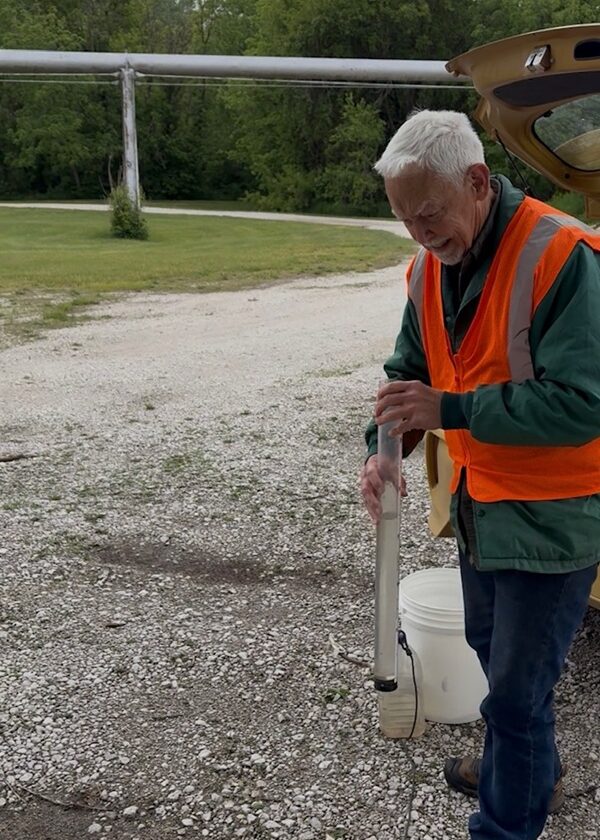
I was a part of the five teams on Tuesday, May 19, that tested water in 35 different creeks, sloughs, and rivers in Greene County. For the past four years Bob has annually coordinated the testing of a combined 150 testing sites in Greene County to establish a data base with the Izaak Walton League of America, SAVE OUR STREAMS. He’s pictured testing water in Washington Township.
For a bit of history from 1999-2017, the Iowa Department of Natural Resources facilitated the IOWATER program which trained and supported volunteer water quality monitoring across the state. IOWATER volunteers monitored thousands of sites across Iowa and produced tens of thousands of data points. When the IOWATER was disbanded in 2017, these volunteers were left with no centralized training or support and no platform for data submission.
The Izaak Walton League of America’s Save Our Streams (SOS) program had been at work around the country since 1969 and in 2019 the SOS program was re-engineered for Iowa. SOS stepped up to create a new support system for statewide volunteer water quality monitoring in Iowa, filling the gap left in IOWATER’s absence.
The data collected from the water samples included dissolved oxygen, pH, chloride, phosphate, nitrate, transparency of the water, and temperature of the water and the air. Also included was the appearance of the stream and the surrounding banks. (I reflected on the diary of early Greene County pioneer Gilliam Tolliver as he wrote about looking at the Raccoon River and being able to see fish swimming.) Weather data for the day and the previous two days were also documented.
Nitrates are on the minds of many people, including the public servants from our Iowa legislature and those candidates seeking public service. The legislature recently provided a one time $25 million appropriation to the Central Iowa Water Works for the expansion of nitrate removal capacity. The public consensus, though not totally scientifically proven, is that the elevated nitrate levels are causing Iowa to have surge in cancer diagnoses. Iowa’s overall cancer rate is 10 percent higher than the national average and is second only to Kentucky in the rate of new cancer diagnoses.
While recording on the seven sites I visited, the nitrate levels were an average of 7. Average for all thirty-five testing sites was 13. This is upstream from the Des Moines Water works where yesterday, May 27, the nitrate level in the Raccoon River was 17.17 milligrams per liter. The federal government recommended bar is no more than 10 milligrams per liter for the safety of the user. (source was the Des Moines Register).
In addition to testing water at Snake, Hardin, and Buttrick Creeks and the Raccoon River (two testing sites) I learned the location of Tipton and Shiner Creeks.
As many of you are aware, I was a public health nurse prior to retirement. Prevention of accidents and ill health/disease was paramount in the profession. Many conference speakers used the illustrative story of people frequently drowning in a river. The public health professional went upstream and placed a fence across the river where the people were falling into the water. This analogy seems parallel to providing an additional $25 million to filter nitrates rather than going upriver.
Additional volunteer water testers are always accepted and welcomed. Contact a member of the Friends of Greene County Parks, or the Greene County conservation office, or environmental activist, Bob Rye.
VIEW FROM MY WINDOW is shared by Mary Weaver of rural Rippey.